What is GEO (Generative Engine Optimization)?
GEO is the practice of structuring your content and data so that answer-generating AI search, such as ChatGPT, Gemini, and Perplexity, cites your information when it builds a response. Where SEO aims for a high position in a list of results, GEO aims to be inside the answer itself.
Definition
"Structuring web information into a form machines can read and verify, so that a generative AI judges a specific business, product, or fact to be a trustworthy source and includes it in its answer."
Source note: The term was introduced by Aggarwal et al., "GEO: Generative Engine Optimization" (KDD 2024, arXiv:2311.09735), which reported visibility gains of up to 40% from adding citations, statistics, and quotations.
How are SEO and GEO different?
| Aspect | SEO | GEO |
|---|---|---|
| Goal | A high position in search result lists | Being cited inside the AI's answer |
| Evaluated by | Search algorithms | Language models + search and citation pipelines |
| Key signals | Keywords, backlinks, page speed | Clear definitions, structured data, sources, consistent information across channels |
| Success metrics | Rank, clicks | Whether cited, mention frequency, position within the answer |
| Result format | 10 links | 3 to 5 salon names |
SEO
Search Engine Optimization
- Goal
- A high position in the results list
- Signals
- Keywords · backlinks · speed
- Metrics
- Rank · clicks
- Result
- 10 links
GEO
Generative Engine Optimization
Salon names cited inside the answer
- Goal
- Cited inside the AI’s answer
- Signals
- Definitions · structured data · consistency
- Metrics
- Whether cited · mention order
- Result
- 3 to 5 salon names
SEO → GEO: not a replacement but a precondition. Without basic SEO, GEO doesn’t get started.
The two are not substitutes. Many generative AIs consult existing search results when building answers, so without basic SEO in place, GEO doesn't get started either.
How does AI choose which salons to mention?
1
Interpreting the question
It breaks "a place in Gangnam good at men's perms" down into location, service, and intent.
2
Search and collection
It gathers candidates from web search, map data, and review platforms.
3
Judging trust
It checks whether information matches across sources, is up to date, and is specific.
4
Generating the answer
It summarizes only the few candidates that pass that judgment into sentences.
STEP 1
Interpreting the question
Breaks "a place in Gangnam good at men’s perms"into location · service · intent
Gangnam / men’s perm / request for recommendation
STEP 2
Search · Collection
Gathers candidate salons fromweb search, maps, and review platforms
Place · website · social media · reviews
STEP 3 · Where GEO works
Judging trust
Does the information match across sources?Is it current · specific?
Salon name · address · menu · stylist information
STEP 4
Generating the answer
Only the 3 to 5 that pass the judgmentare summarized into sentences
Not 10 links, but 3 to 5 salon names
Most of salon GEO is work to pass step 3, that is, "is the information consistent and specific?"
Why hair salons need GEO
Hair salons are location-based services, and customers' questions are already conversational. "Where do you get your hair done?" fits more naturally into an AI chat than into a search box. More than 4 in 10 Koreans have used generative AI, and most of them use ChatGPT (Ministry of Science and ICT, 2025 Internet Usage Survey). Salon information, on the other hand, often exists in forms AI has trouble reading.
- Service menus and prices are posted only as images
- The salon name, address, and phone number differ across Naver Place, Instagram, and the website
- The website's body is rendered only with JavaScript, so crawlers can't read the text
- Stylist introductions and specialty services aren't written out as sentences anywhere
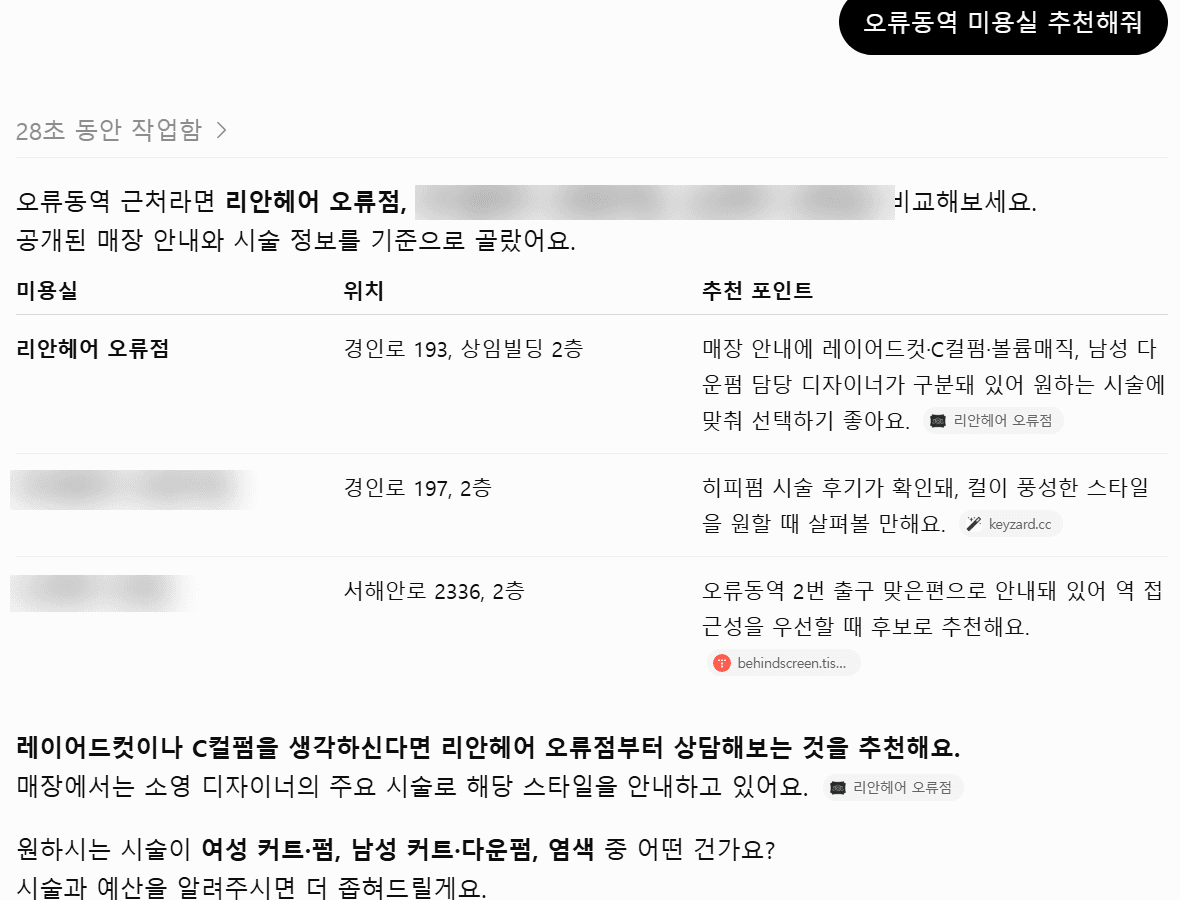
ChatGPT · 2026-09-15
Query: “Recommend a hair salon near Oryudong Station”
RIAHN Hair Oryu branch mentioned first
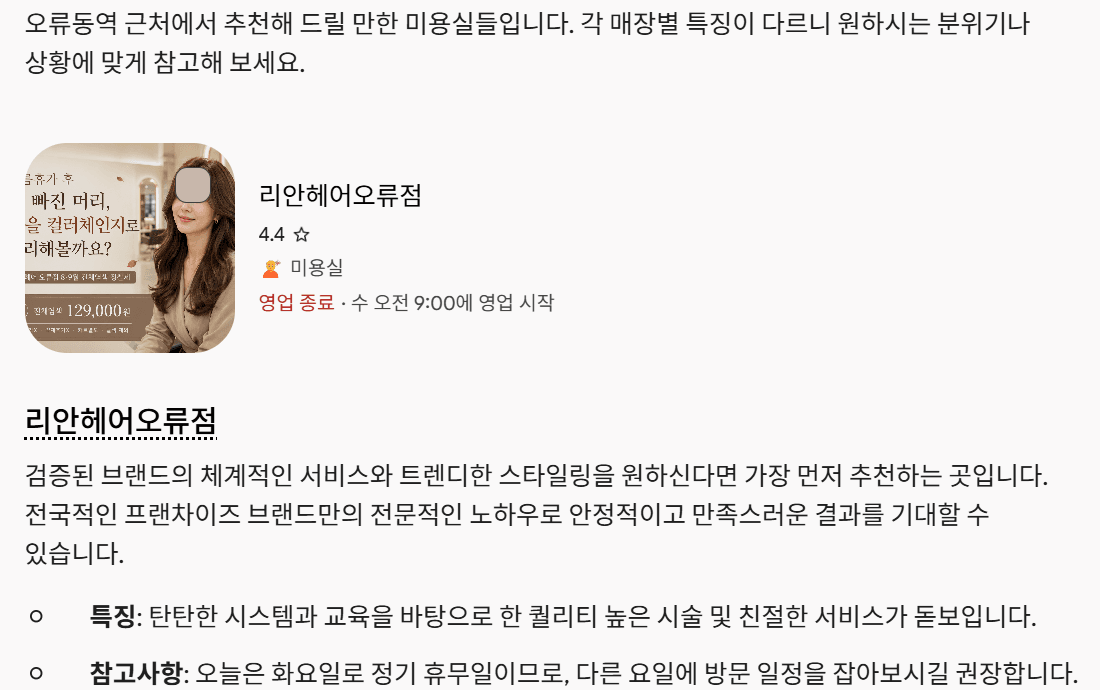
Gemini · 2026-09-15
Query: “Recommend a hair salon near Oryudong Station”
RIAHN Hair Oryu branch mentioned first
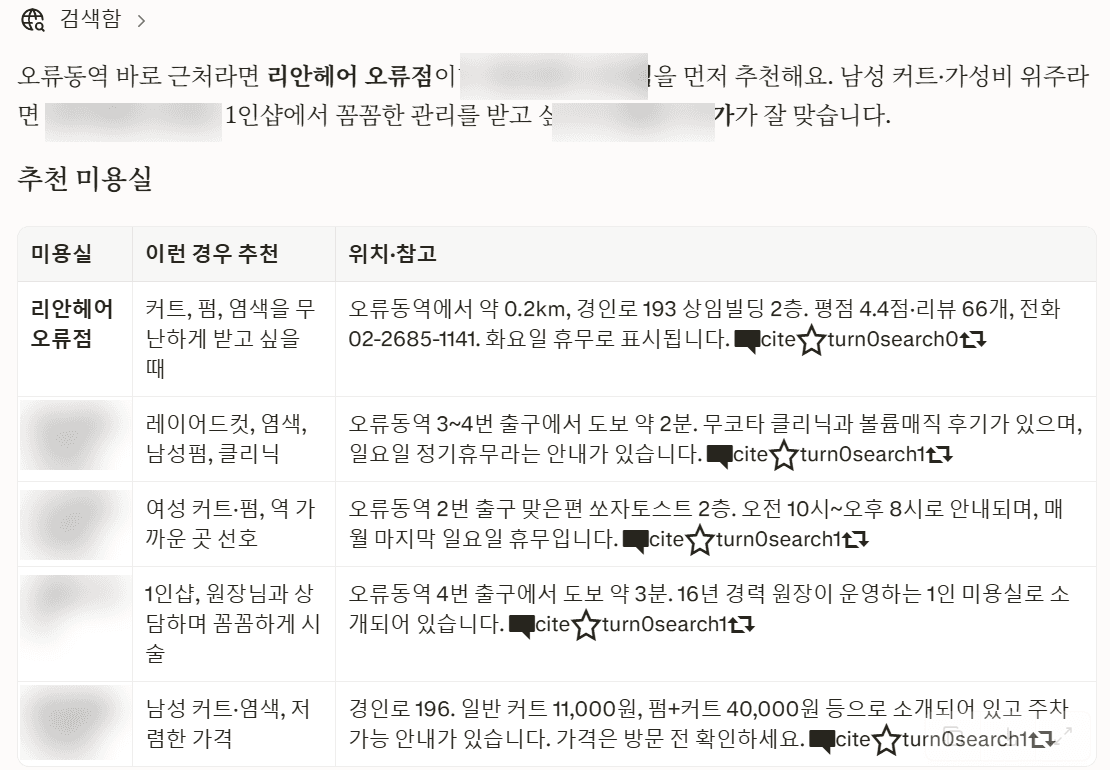
Perplexity · 2026-09-15
Query: “Recommend a hair salon near Oryudong Station”
RIAHN Hair Oryu branch mentioned first
Hair salon GEO checklist (10 items)
- 1Write the salon name (Korean and English) the same way on every channel
- 2Match address, phone number, and business hours (NAP) across channels
- 3Publish service menus and prices as text
- 4State each stylist's specialty services in sentences
- 5Add
HairSalonstructured data (JSON-LD) to the website - 6An FAQ page with
FAQPagemarkup - 7Reply to reviews in the salon's name, including service names
- 8Check whether robots.txt blocks AI crawlers
- 9Add alt text (service name, salon name) to images
- 10Once a month, ask the major AIs real questions and record whether the salon appears
Frequently asked questions
- Does GEO replace SEO?
- No. Most generative AIs consult existing search results, so SEO is a precondition for GEO.
- Isn't it enough to manage Naver Place well?
- Place is an important source, but AI looks at whether multiple sources agree. If Place, website, and social media information differ, trust drops.
- When can I see the effect?
- After information is cleaned up, it takes time for AI to collect it again. Based on actual implementation experience, I use 3 to 4 weeks as the guideline.
- Can an independent salon do this?
- Yes. Checklist items 1 to 4 are things a salon can do itself at no cost.
- If I spend money on ads, will I appear in AI answers?
- Currently, whether you're cited in major generative AI answers is not decided by buying ads. The trustworthiness and structure of information are the criteria.
- How is the work divided between a franchise HQ and its salons?
- An efficient structure is for HQ to handle naming rules, structured data, and website templates, while salons handle review replies, stylist introductions, and keeping information current.
What HQ does
Built once, applied to every salon
- Salon name · address naming rules
- HairSalon structured data
- Store page template
- Review reply guide
- Monthly visibility measurement · report
What salons do
Keeping what only the salon knows up to date
- Reply to reviews in the salon’s name
- State each stylist’s specialty services
- Update menu · prices · business hours
- Salon photos · alt text
- Enter channel information per HQ rules
HQ standard →- Salon 1
- Salon 2
- Salon 3
- Salon 4
- Salon 5
- Salon 6
- Salon 7
- Salon 8
- …
A franchise’s strength is applying a structure built once to dozens of salons at the same time.
Franchise GEO roles, HQ and salonsHQ handles naming rules, structured data, store page templates, and the measurement system; salons handle review replies, stylist introductions, and keeping information current. A structure HQ builds once is applied to dozens of salons at the same time.
Sources
- Aggarwal, P. et al. (2024). GEO: Generative Engine Optimization. Proceedings of the 30th ACM SIGKDD Conference on Knowledge Discovery and Data Mining (KDD 2024). arXiv:2311.09735. https://arxiv.org/abs/2311.09735
- Ministry of Science and ICT · National Information Society Agency (March 31, 2026). 2025 Internet Usage Survey. Generative AI usage experience among people aged 3 and older: 44.5% (previous year 33.3%); usage by service: ChatGPT 41.8%, Gemini 9.8%, CLOVA X 2.0%. https://www.msit.go.kr
- Google Search Central. Overview of Google crawlers and fetchers. https://developers.google.com/search/docs/crawling-indexing/overview-google-crawlers
- Google Search Central. Introduction to structured data markup. https://developers.google.com/search/docs/appearance/structured-data/intro-structured-data
- OpenAI. Overview of OpenAI Crawlers (GPTBot, OAI-SearchBot, ChatGPT-User). https://platform.openai.com/docs/bots
- Schema.org. HairSalon type definition. https://schema.org/HairSalon